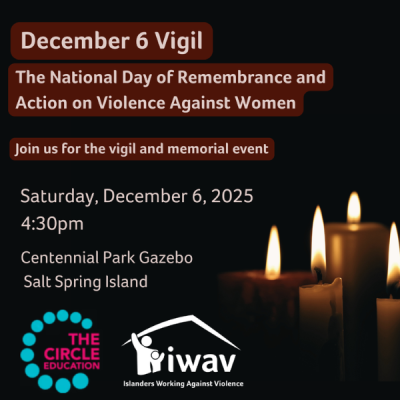
Saturday, December 6 · 4:30pm
Centennial Park Gazebo, Salt Spring Island
Every December 6th, communities across Canada gather to honour the National Day of Remembrance and Action on Violence Against Women.
We remember the 14 women murdered at Montréal’s École Polytechnique in 1989 on this day. On December 6, we remember:
- Geneviève Bergeron
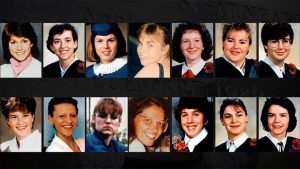
- Hélène Colgan
- Nathalie Croteau
- Barbara Daigneault
- Anne-Marie Edward
- Maud Haviernick
- Maryse Laganière
- Maryse Leclair
- Anne-Marie Lemay
- Sonia Pelletier
- Michèle Richard
- Annie St-Arneault
- Annie Turcotte
- Barbara Klucznik-Widajewicz
We hold space, too, for all women, girls, and gender-diverse people whose lives have been taken by gender-based violence.
IWAV and The Circle Education will once again co-host a community candle-lighting ceremony at the Gazebo in Centennial Park. Together, we will honour the women and girls killed by femicide in 2025 and renew our commitment to creating safety, justice, and dignity for all.
Violence rooted in misogyny and systemic oppression continues to shape lives across this country. We honour women and girls lost to gender-based and intimate partner violence; missing and murdered Indigenous women, girls, and 2SLGBTQIA+ people; Black, Indigenous, and women of colour who face disproportionate harm; and trans and gender-diverse people targeted for who they are.
Gender-Based Violence Remains a National Emergency
Every 48 hours in Canada, a woman or girl is killed in an act of gender-based violence. In 2024, 240 women and girls were murdered, a 54% increase over pre-COVID levels.
According to the Canadian Femicide Observatory for Justice and Accountability (CFOJA), 133 women and girls were violently killed in 2025:
- Where an accused was identified, 93% were men.
- 46% of victims were killed in rural or small-town communities – places much like the Southern Gulf Islands.
- 50% were killed by a current or former intimate partner; 28% by a family member.
- 77% were killed in their own homes or another private residence.
Rural and small-island communities experience higher rates of intimate partner violence and femicide than urban centres. Geographic isolation, limited services, tight-knit social networks, and reduced anonymity can all increase risk and make it harder to seek help. On islands like ours, these realities deepen the importance of showing up for one another – and strengthening safety nets close to home.
IWAV’s Impact in the Southern Gulf Islands
In 2024–25, IWAV provided safety, housing, and support to hundreds of people across our region:
- The Transition House, which provides safe emergency housing for up to 30 days for women and children of all genders, supported over 50 women and children and answered 457 crisis calls this year.
- The Cedars, IWAV’s second-stage housing program offering up to 18 months of stable housing for those rebuilding their lives, supported 10 women and 5 children.
- The Stopping the Violence Outreach program, which offers safety planning, advocacy, and emotional support, served 43 women.
- The PEACE Program, focused on prevention, counselling, and caregiver support, served 12 children and 20 caregivers.
- STV Counselling, which provides counselling for women affected by relationship violence, sexual assault, and childhood abuse, supported 48 women.
- The Sexual Assault Response Program, offering crisis support, counselling, and accompaniment for survivors aged 13 and older, served 19 clients.
This gathering is a time to remember, to grieve, and to stand with survivors. It is also a moment to strengthen our resolve—to build a community where every person lives safely, freely, and without fear.
Please bring a candle, or light one with us.
All are welcome.